
Enhance the customer experience with the help of an intelligent ChatBot
Starting point
An established wine retailer wants to offer its customers easy and well-founded guidance when choosing wines, both in its online shop and in its physical stores. The wide range of products, combined with customers' frequent uncertainty, is a particular challenge. Classic filter mechanisms and purely technical optimizations fall short here. Together with Etribes, the retailer therefore developed an AI-based sommelier that draws on comprehensive wine knowledge and provides individual, contextual recommendations. Particular attention was paid to smooth integration into the existing system landscape, in order to create an intelligent, data-based customer experience that specifically improves the shopping experience.
Do you have an exciting idea for a joint project? We look forward to hearing from you at connect@etribes.de.
Approach
A ready-to-use prototype in 5 weeks
Customer journey & use case concept.
Potential areas of application were identified as part of the online, offline and omnichannel journey. Based on this, a shortlist of relevant use cases was developed for the later test phase in the shop. Finally, specific recommendations for integrating these use cases into the existing shop design were developed.
Development and implementation.
We developed a service that connects to OpenAI and provides chatbot functionality via clearly defined APIs. Product data is converted into embeddings using a large language model (LLM) and indexed in a vector database. In addition, an interactive chat interface was implemented in the frontend, enabling smooth communication with users.
Handover & maintenance
The last step was to create the documentation, which contains all relevant information about the project. The results were then handed over to the internal teams. Optionally, a maintenance phase can also be added. This includes necessary and regular updates, bug fixing and support for technical questions or problems.
Result
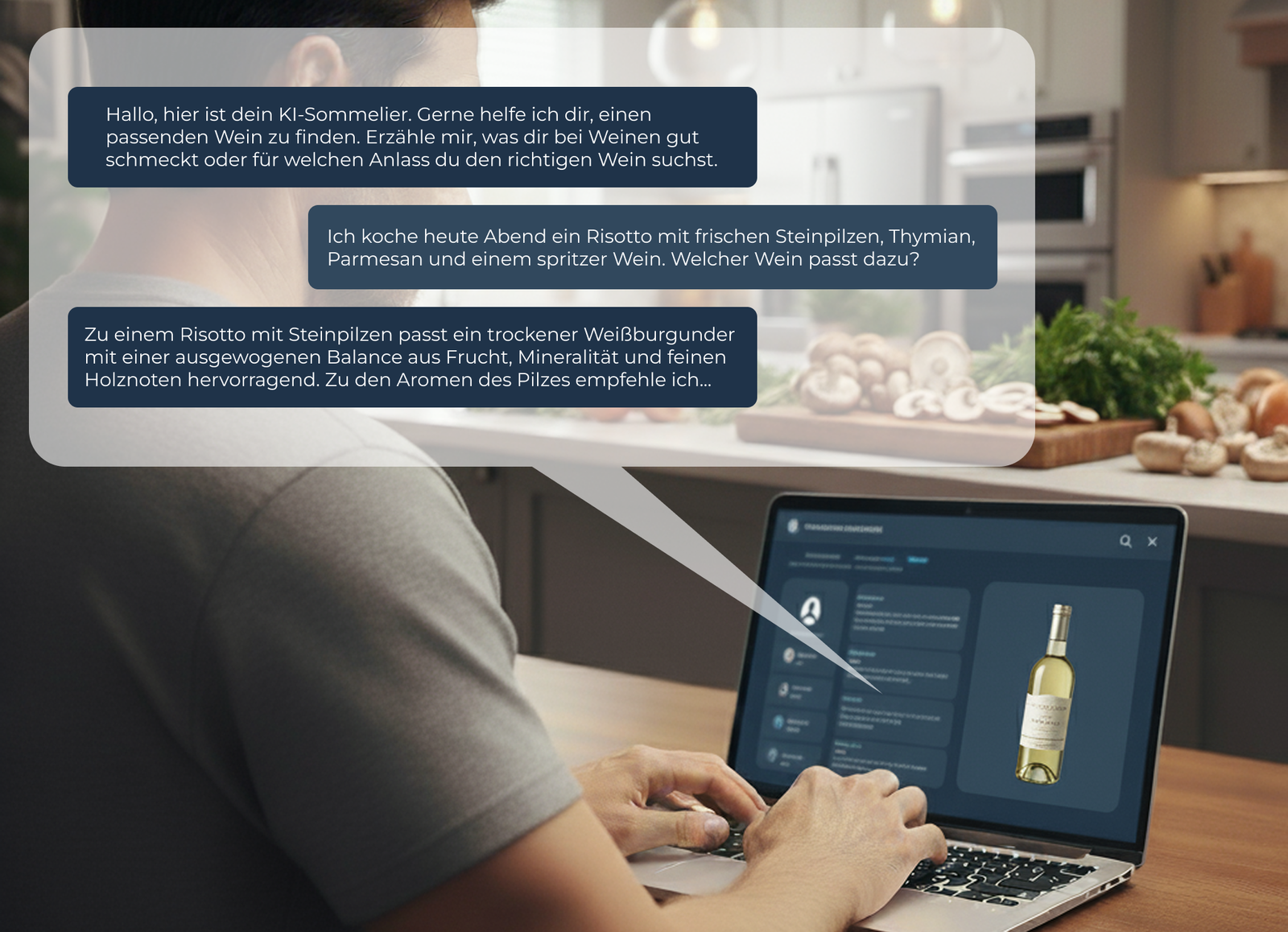
The aim of the project was to create an intelligent recommendation solution that integrates smoothly into the wine retailer's digital ecosystem. Based on OpenAI technology and fine-tuned using wine knowledge databases, the architecture draws on millions of wine data records and structured knowledge. Customers can ask specific questions, for example about the right wine to pair with a dish or about particular taste profiles, and receive well-founded answers in real time.
Technology implementation and integration
Etribes was responsible for the design, implementation, monitoring and operation of the AI solution, with particular emphasis on user guidance and precise data preparation. The AI was fine-tuned so that it not only reliably answers standard questions, but also makes sense of more demanding queries about wine styles, aromas or preferences. Thanks to its minimally invasive integration into the company's existing architecture, the tool went live efficiently and without major hurdles.
Added value for customers and retailers
The introduction of the AI sommelier improves the customer experience in the long term. Customers receive personalized recommendations, while the wine retailer benefits from increased interaction and more targeted purchase decisions. The solution is particularly helpful where personal advice is not always available, whether in a local shop or when searching online for the right wine.
Takeaways
Use cases along the customer journey. The team looked for touchpoints for the AI sommelier online, offline and across channels. That produced a shortlist for testing in the shop.
Wine knowledge in the model. Product data sits as embeddings in a vector database, and the model is fine-tuned on wine knowledge. It handles questions about aromas or food pairings.
Minimally invasive integration. The solution connects to the existing architecture through clearly defined APIs. That let it go live without major hurdles.
- 5 weeks
- to a ready-to-use prototype
More cases
From our other projects.
- Services and platforms
The “Negotiation Companion” for the future of purchasing
11× more supplier analysis as the target of the concept - mymuesli Consumer goods and brands
AI First: A new user experience in just 8 weeks
80 % of the functional design scaled by AI -
Retail and e-commerce
Cyberport’s journey to becoming an AI-first company
−95 % time to live per feature, planned target path


Next step
Your project is still missing here.
You tell us where things get stuck. We tell you where to start and what it takes.
